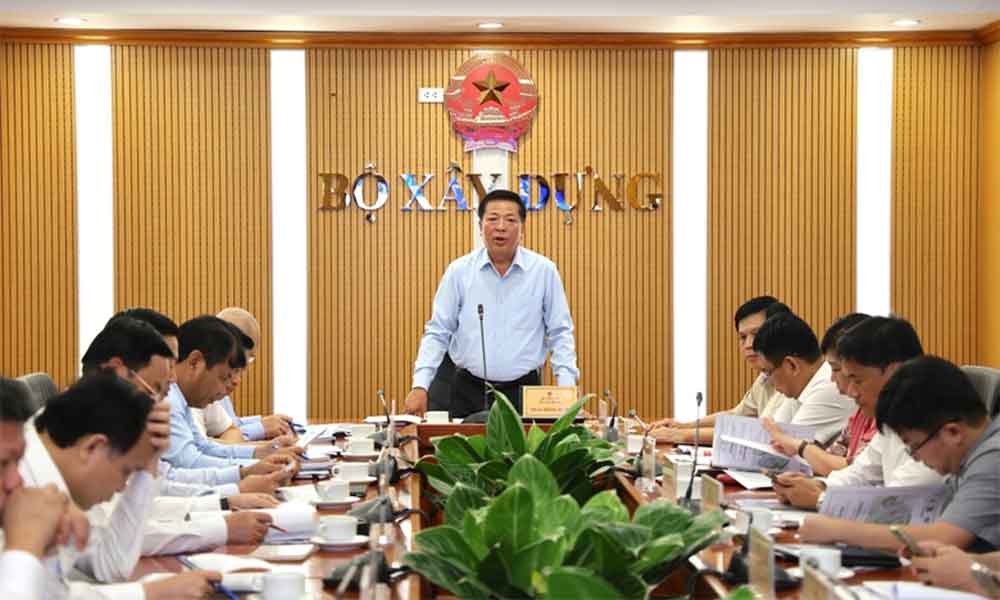
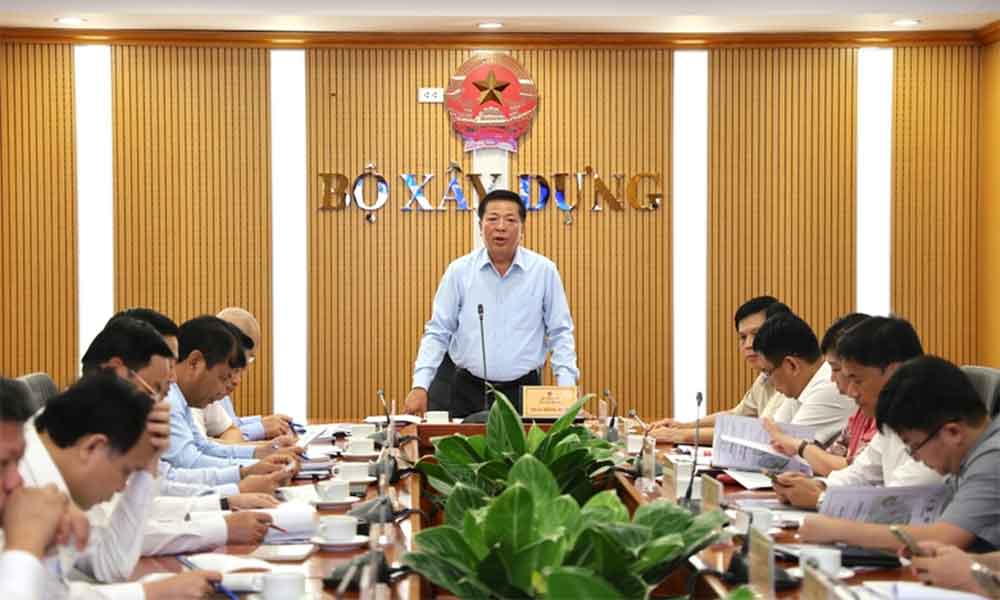
Minister of Construction Tran Hong Minh chaired a meeting with local authorities regarding the investment project for the construction of Ring Road 5 – Capital Region. The road passes through the territory of 7 localities, with the section through Bac Ninh being nearly 50km long.
This morning (May 13th), Minister of Construction Tran Hong Minh chaired a meeting with local authorities regarding the pre-feasibility study report for the investment project to build Ring Road 5 – Capital Region.
National key project, investment roadmap before 2030
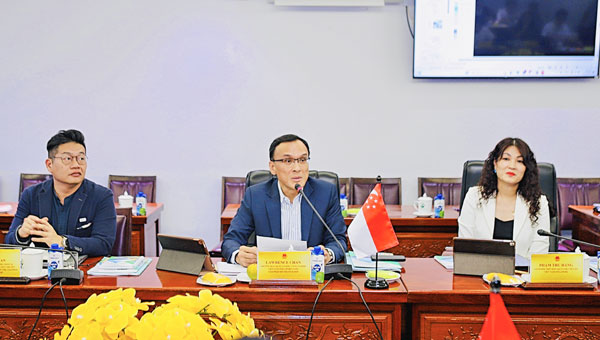
Reporting at the meeting, the Thang Long Project Management Board and the consortium of consultants leading the road design and consulting company (HECO) stated that the investment project to build Ring Road 5 – Capital Region is a nationally important project.
According to the Action Program for implementing the Resolution of the 14th National Congress of the Party, the Ring Road 5 is identified as a key project, expected to be implemented in the period 2026 – 2030.
Resolution No. 30-NQ/TW dated November 23, 2022, of the Politburo on socio-economic development and ensuring national defense and security in the Red River Delta region until 2030, with a vision to 2045, has determined: “By 2030, complete the radial expressways and ring roads of the Capital region (prioritizing ring roads 4 and 5).”
The National Master Plan for the period 2021-2030, with a vision to 2050, and the Road Network Plan for the period 2021-2030, with a vision to 2050, also identify the Ring Road 5 as having an investment roadmap before 2030.
Therefore, researching and investing in the Ring Road 5 project during the 2026-2030 period is necessary and consistent with the Party and State’s policies and relevant planning.
Furthermore, investing in Ring Road 5 will meet the growing transportation needs in the most dynamically developing region of the country; enhance connectivity and synchronize transportation infrastructure between Hanoi and the provinces in the Northern key economic region; improve transportation capacity, and contribute to promoting socio-economic development of the region.
Based on that, in the pre-feasibility study report, the consultant proposed investment objectives for the project aimed at completing infrastructure, creating momentum to promote comprehensive socio-economic development; improving the quality of life for the people; opening up opportunities to attract investment and develop the local economy; and simultaneously fulfilling the objectives of the Road Network Planning for the period 2021–2030, with a vision to 2050.
The specific objectives of the project include: Meeting transportation needs, reducing congestion, and ensuring traffic safety on the Ring Road 5; Completing and putting into operation a comprehensive network of high-capacity, safe, and high-speed expressways along the transportation corridor of the provinces in the Red River Delta region.
Strengthening regional linkages, promoting cooperation and development between the Red River Delta and the Northern Midlands and Mountains; enhancing the competitiveness of the economy in the context of deep integration; gradually completing the road transport network according to the plan; contributing to ensuring national defense and security.
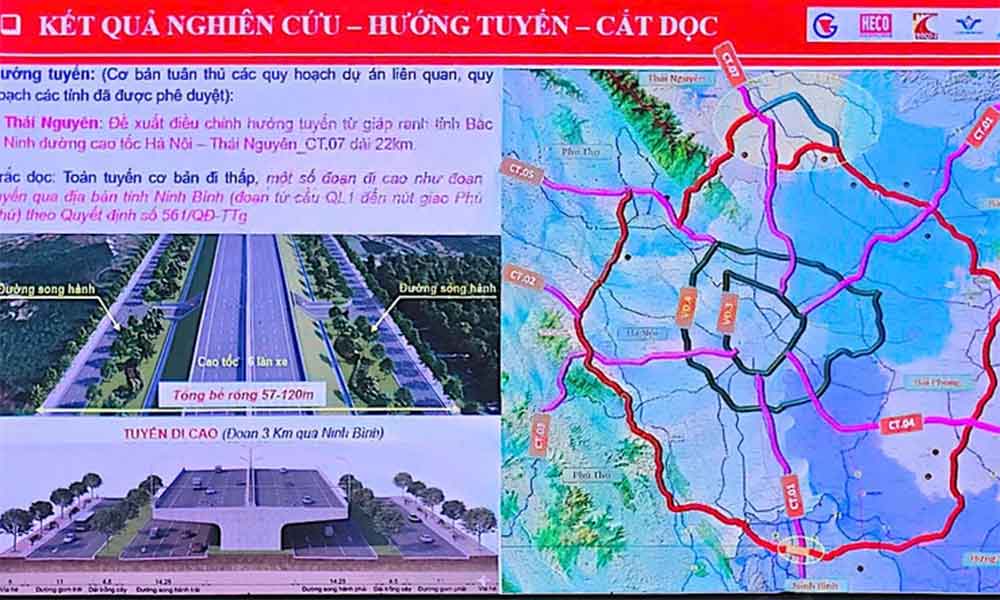
According to the consultant’s proposal, the project starts at Km0 (corresponding to Km 367+100 of the Ho Chi Minh Highway), located in Yen Bai commune, Hanoi city; the end point coincides with the starting point, forming a closed loop.
The total length of the route is approximately 340km (excluding 33km that overlaps with the Hanoi – Thai Nguyen Expressway and the Hanoi – Lao Cai Expressway).
The route passes through the territory of 7 localities including: Hanoi City (51km), Ninh Binh (36km), Hung Yen (27km), Hai Phong City (63km), Bac Ninh (49km), Thai Nguyen (36km) and Phu Tho (78km).
Regarding investment scale, the main expressway is proposed to be built with 6 lanes according to the plan; the section through Thai Nguyen (from Km 248+124 to expressway CT.07) will have 4 lanes; the design speed is 100-120 km/h.
Local authorities simultaneously plan for parallel roads, green spaces, and sidewalks. The total width of the cross-section (including the highway, parallel roads, and green spaces) must be at least 120m.
Based on the scale mentioned above, the preliminary total investment is approximately 265,517 billion VND, of which the cost of land clearance and resettlement is about 81,356 billion VND.
Carefully research the investment methods and scale to avoid waste.
In providing feedback on the project’s pre-feasibility study report, representatives from the localities generally agreed with the route options proposed by the consultant. For areas where multiple options remain, further thorough review and evaluation are needed before deciding on route adjustments.
For intersections, it is necessary to review and accurately forecast traffic flow to select the optimal technical solution, determine the investment scale and appropriate intersection organization; ensuring that it meets the requirements for land reserve while ensuring smooth traffic flow, quickly releasing vehicles, and avoiding the formation of bottlenecks and congestion in the future.
Regarding investment methods, localities proposed applying public investment, using central government budget funds to ensure early, efficient, and feasible project implementation. Localities are currently facing many difficulties in balancing their budgets due to having to allocate resources to implement many central government projects in their areas, including land clearance and other assigned projects.
Mr. Do Thanh Trung, Chairman of the People’s Committee of Hai Phong City, said that in the medium term, the city must allocate over 90,000 billion VND to implement central government projects in the area; at the same time, it must fulfill its obligation to remit 20% of land revenue to the central government as stipulated by the State Budget Law, equivalent to approximately 19,000 billion VND per year.
The city is also implementing two important railway projects, including the Lao Cai – Hanoi – Hai Phong line and the planned Hai Phong – Ha Long – Mong Cai line, along with many other maritime and waterway projects, therefore the pressure on funding is very high.
Units under the Ministry of Construction requested the consultants to continue reviewing and updating forecasts of transportation demand and traffic volume on the main route, at intersections, and on parallel roads to determine the appropriate investment scale. At the same time, factors such as the transition to green vehicles, climate change, and flood control capabilities should be taken into account; a thorough study of toll station and rest stop options is needed to accurately determine the total investment for the entire route.
Deputy Minister of Construction Le Anh Tuan emphasized that the deadline for completing the pre-feasibility study report is very urgent in order to report to the competent authorities in time, aiming to submit it to the National Assembly for consideration of the investment policy at the next session.
Therefore, localities are requested to provide written feedback on the draft report; and at the same time, carefully study the route options in their areas, and if necessary, promptly adjust local planning to ensure consistency.
The Deputy Minister noted that localities need to carefully study investment methods and funding sources, especially for parallel road systems, as these are directly related to the responsibilities of management, operation, and exploitation after the project is completed.
In agreement with the opinions of localities and relevant agencies, Minister of Construction Tran Hong Minh affirmed that this is a nationally important project, and also a key transportation project of the construction industry, implemented according to the Action Program to implement the Resolution of the 14th National Congress of the Party.
Despite the urgent timeframe, the project requires thorough and systematic research with a long-term vision of 50-100 years; the implementation methods need to be innovative and creative; and all relevant plans, including local plans, must be reviewed and fully updated to ensure consistency and long-term effectiveness.
Regarding specific details, the Minister requested that the consultants conduct a study to standardize the investment scale for the main route with 6 lanes, with provision for expansion to 8 lanes for the section passing through Hanoi.
Simultaneously, research is being conducted on investing in two parallel routes; however, close coordination with local authorities is necessary to specifically assess each location and each section of the route passing through residential areas, urban areas, industrial zones, and connection points with the existing road system.
Based on that, clearly identify which sections require parallel roads and which only need local roads or access roads of appropriate scale, ensuring investment efficiency and avoiding waste.
For bridge projects along the route, the placement of smaller bridges will be based on the geographical area of each province, in accordance with the route design. However, the three large bridges connecting two localities – Vinh Thinh Bridge, Thai Ha Bridge, and Luoc River Bridge – will be the responsibility of the Ministry of Construction for investment.
The system of pedestrian underpasses also needs to be studied, and a unified design option should be selected to ensure technical requirements, aesthetics, and vehicle clearance, while also having appropriate drainage solutions to create favorable and safe conditions for motor vehicles to circulate between the two parallel roads on either side of the expressway.
In addition, interchanges, rest stops, and toll stations need to be carefully studied based on feedback from local authorities and relevant units, ensuring consistency, safety, and operational efficiency.
In particular, issues related to the environment and technical infrastructure, such as the placement of charging stations and battery swapping stations along the route to serve electric vehicles, need to be considered and integrated into the current research phase.
The Minister requested the Thang Long Project Management Board and the consulting unit to seriously and fully incorporate all feedback, finalize the pre-feasibility study report, and ensure the quality, progress, and feasibility of the project.